Get news from Weitz Sports Chiropractic and Nutrition in your inbox, and receive a free ebook on digestive health.
By submitting this form, you are consenting to receive marketing emails from: Dr Ben Weitz, DC, CCSP, CSCS, 3435 Ocean Park Blvd.,, STE 101, Santa Monica, CA, 90405, http://www.drweitz.com. You can revoke your consent to receive emails at any time by using the SafeUnsubscribe® link, found at the bottom of every email. Emails are serviced by Constant Contact
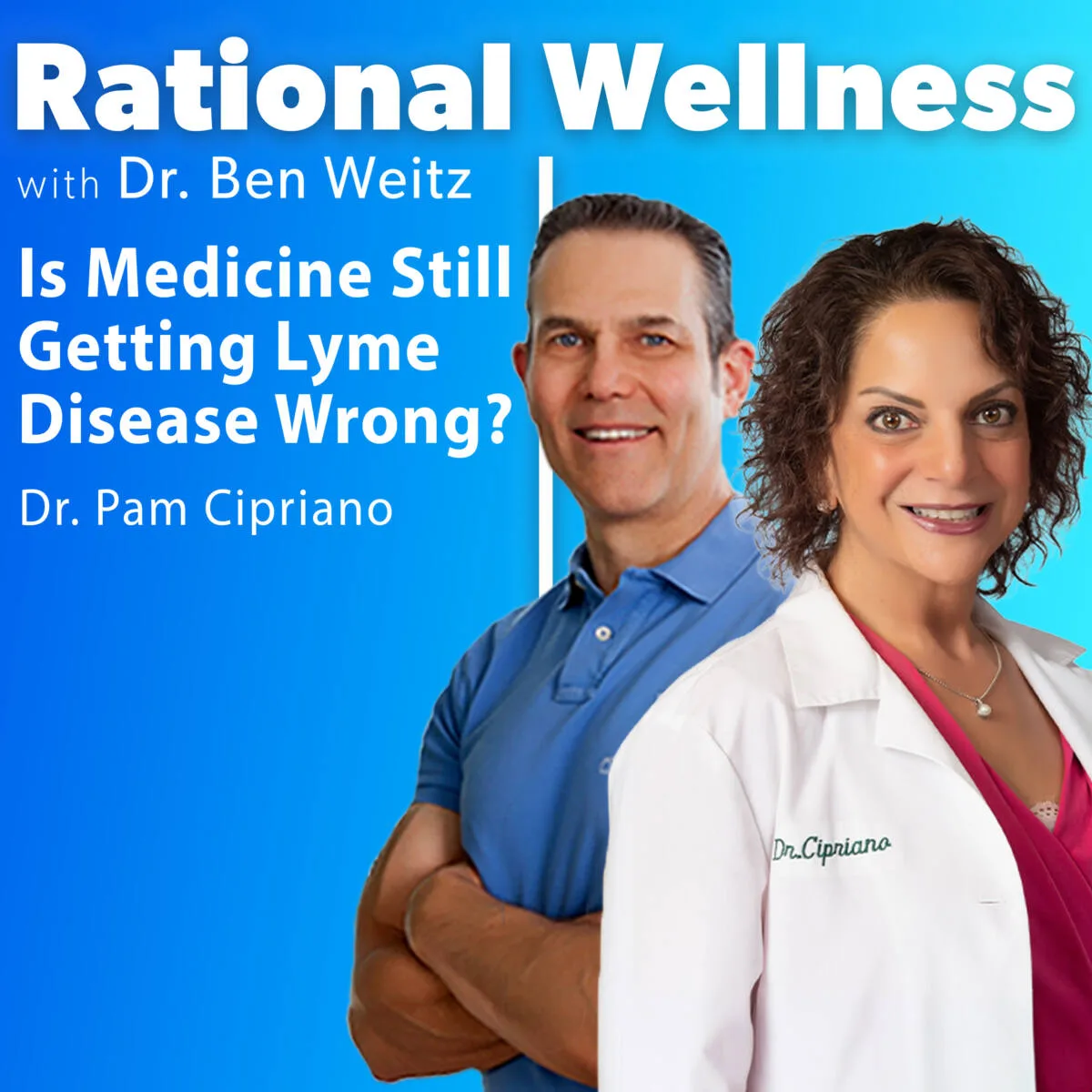
Is Medicine Still Getting Lyme Disease Wrong with Dr. Pam Cipriano: Rational Wellness Podcast 457
Show Notes:
Dr. Pam Cipriano is a Doctor of Nursing Practice and Functional Medicine practitioner who specializes in complex, chronic conditions like Lyme Disease and other tick-borne illnesses. Dr. Cipriano is the founder of The Practice of Health and Wellness in Thomaston, CT and her phone number is 860-880-2525.
Dr. Ben Weitz is available for Functional Nutrition consultations specializing in Functional Gastrointestinal Disorders like IBS/SIBO and Reflux and also Cardiometabolic Risk Factors like elevated lipids, high blood sugar, and high blood pressure. Dr. Weitz has also successfully helped many patients with managing their weight and improving their athletic performance, as well as sports chiropractic work by calling his Santa Monica office 310-395-3111.
Transcript:
Dr. Weitz: If you’re looking for clinically useful insights, not wellness hype, then this is the place for you. Welcome to the Rational Wellness Podcast, the podcast for functional and integrated practitioners who wanna practice with greater clarity and precision. I’m Dr. Ben Weitz, and each week I sit down with the leading clinicians, researchers, and lab innovators to explore the science lab testing and clinical reasoning behind modern root cause medicine. This is a show focused on practical evidence informed insights that you can actually use in patient care. Please subscribe to the Rational Wellness Podcast on Apple, Spotify, or YouTube. Please tell your friends and colleagues and if you could give us a ratings and review on Apple or Spotify. We would certainly appreciate it. Finally, to access the show notes and the full transcript, please go to my website, drweitz.com.
Hello, today I’m excited to be joined by Dr. Pam Cipriano on the hidden root causes of chronic illness that mainstream medicine often misses. Let’s see. We will be joined by Pam Cipriano. She is a, uh, nurse practitioner and a functional medicine practitioner who specializes in complex chronic illnesses, especially Lyme disease and other vector-borne conditions. She’s the founder of the practice of health and Wellness. Where she takes a root cause whole person approach combining eastern and western medicine to treat the underlying drivers of disease and not just the symptoms. She trained under the renowned Lyme specialist, Richard Horowitz, and is a member of the International Lyme and Associate Disease Society.
In today’s conversation, we’re going to dive into [00:02:00] why Lyme disease is so frequently missed, how to think about chronic infections through a functional medicine lens, and what it really takes to help these patients recover. Dr. Cipriano, thank you so much for joining us today.
Dr. Cipriano: Thank you so much for having me. I really appreciate it.
Dr. Weitz: So we’re gonna have this discussion about vector-borne diseases like Lyme disease,and Lyme disease is so commonly missed or dismissed in conventional medicine. Why do you think that is?
Dr. Cipriano: Well, I don’t think it’s taught in medical schools. I think it’s a very politically driven disease process, and I feel as though if you are on the medical staff at a hospital, you don’t wanna be the odd man out who’s treating Lyme disease. You don’t want to be the one that goes against the grain. I have never been like, I’ve never been the, the cool kid on the [00:03:00] block. I’ve never really cared if I fit in or not. I always try to do the right thing. And so it just kind of passed on into my adulthood that, um, I just help people one by one.
I’m not really, I don’t really care too much about what my colleagues think about me. I care more about how I treat my patients. I recently had a research study published. It was published, um. Nine days ago actually in the Curious Medical Journal, and it was based on Lyme disease, uh, causing seizures in two of my patients.
And this morning I actually received an email from somebody who lives in Canada. She, same thing’s happening in Canada where the doctors are just dismissing her that, you know, her seizures couldn’t possibly be caused by Lyme disease and she’s been trying to fight for IVIG treatment and now that she has research in her hand, they’re more likely to follow suit and start giving her what she absolutely needs to stop the seizures from occurring.
Dr. Weitz: That’s great. I, I don’t think seizures is recognized as something that’s liable to result from Lyme disease. So I guess there’s a number of neurological conditions that can result from Lyme disease that are not on the radar.
Dr. Cipriano: That’s correct. So Lyme disease is, the actual bacteria is borreliosis. So Lyme. So something like Lyme disease that’s affecting the brain is gonna be caused called neurobras. So somebody with neurobras means that whether it’s the infection that infected the brain or it’s an inflammatory response from the antibiotics causing that her time or reaction, one reason or another is causing the seizure activity.
When you have a patient who’s on a number of anti-seizure medications and they’re still having seizures. They don’t have epilepsy. There’s another reason for the seizure activity, and this is well documented in other disease processes like, um, like H-H-H-S-V-H-C-V, um, but nothing about [00:05:00] Lyme disease and.
It did take, you know, a bit of time for me to get my research published. It was peer reviewed and just like when I did my doctoral dissertation, I had to defend my research and, you know, answer all the questions that they had of why I, why I did certain tests, why I didn’t do other tests, things like that.
Dr. Weitz: Do we think that the bacteria that causes Lyme disease actually gets into the brain, or is it more the the endotoxins that get into the brain?
Dr. Cipriano: So it could be that the bacteria actually got in the brain, even if you did a lumbar puncture. The cerebral spinal fluid is most likely not going to show the, um, borreliosis, even if it did. The testing that we use is so antiquated that we’d still probably get a false negative, but only about 10% of people who do have neurobras where they have the bacteria in the cerebral spinal fluid actually have a positive result. Usually it’s, it’s a false negative.
Dr. Weitz: So what’s [00:06:00] wrong with the testing? What kind of testing is commonly done that’s not accurate? And what kind of testing should we be doing?
Dr. Cipriano: So I think it’s a misunderstanding of the testing, and this is actually in my research and I was able to defend this, um, with a peer reviewer who. Based on the question reminded me of somebody who was an infectious disease specialist. He wanted to know why I didn’t use, um, local testing. The EIA followed by the bands. And the e is a very poor test, you know, um, the college,
Dr. Weitz: Can you explain what Elisa testing is?
Dr. Cipriano: Sure. So the American College of pathologists states that for tests to be recommended, it has to be at least 95% accurate. EIA is a screening tool. It’s was initially used in HIV and now it’s used in other testing as well as Lyme disease.
If the EIA is negative, you don’t get tested for Lyme disease, so it’s a screening tool. If the EIA is [00:07:00] positive, then you’ll get tested for Lyme disease. But even if you were lucky enough to get a positive Eliza, and then we’re tested for Lyme disease, according to the CDC, you have to have two out of three bands under IGM.
Which are all very specific to Lyme disease, or you’d have to have five outta 10 bands in the IgG category. So IgM means you currently have the disease process. IgG means it’s it’s historical in medicine. In Lyme disease, it does not follow that suit. It’s the only disease process that I’m aware of, that you can have a positive IgG and still have an active infection even though your IgM is negative.
So it’s based on how your immune system is responding. But getting back to the testing, the IgG for local testing, so something through LabCorp request. There’s only three bands in, out of those 10 that are directly related to Lyme disease. The other seven bands have nothing to do with Lyme or other tick-borne diseases.
They’re related more to other [00:08:00] bacterias and other viruses. And so even if you had a positive Eliza and you had, you know, five outta 10 bands positive, you still might not have Lyme disease because you could have five bands that have nothing to do related to Lyme disease that are positive for entirely different reasons.
So in my research, I made sure to, to, um. Describe the CD. C on their website is specific. The testing was made originally for epidemiological purposes, so only to track the disease process. It was never designed to, to diagnose a patient with Lyme disease. It’s really a clinical diagnosis, so for example, I live in Connect.
I live on four acres. My whole yard is surrounded by woods. I have four dogs they have that go in and out of the house. We have a cat that goes in and out of the house. My risk of having a tick in my house and getting bitten by a tick is very high. So whether I have a bullseye rash or not, if I present to my doctor’s office with a [00:09:00] sudden onset of symptoms, joint, you know, migrating joint pain, migrating muscle pain.
Um, burning sensation under my feet, chronic headaches that all of a sudden this happened to me and I had no other reason for it. Lyme disease should be at the top of this clinician’s list of differential diagnoses. That is not what happens. They, they almost do anything to try not to think of Lyme disease.
Like I’ve had patients come to me. I had a personal friend come to me. She, um, she felt something bite her on the back of the, the, the leg was a little bit concerning to me because this is reminding me of something that’s other than a tick that could be possibly carrying Lyme disease now, and that’s not in any literature that I’ve read so far, but ticks are so tiny you don’t generally feel them bite you, but she felt it bite her while she was driving.
She thought it was a spider. She smacked it. She couldn’t find it when she got out of the car. About two to four weeks later, she developed a bullseye rash, right where the tick bite or whatever bit her was, and then this bullseye rash was all over her [00:10:00] entire body. So that’s telling me that whatever bit her was did was infected with Lyme disease.
’cause it’s the only way you can get this erythema, migraines, rash. And it got into her nervous system for it to be able to show up in all different areas of her body. So respiratory therapist works at a local hospital, goes to the er. Initially they thought that what looked like a spider bite ’cause she started to get a small abscess there.
She was doing the warm compresses. You’re doing everything right now. She develops all these erythema, migraine rashes all over her body. Now they’re telling her it is ringworm. So she happens to see a hospitalist that I, I used to work with when I was a hospitalist at that hospital, and she agreed it had to be ringworm.
Luckily she called me, she sent me pictures and I was like, you need to get in here right away. That was not ringworm. She actually had Lyme disease that infected her entire nervous system, so she was, because we caught it so fast, she was on antibiotics for six weeks, which usually by the time I get a patient, they’ve had this for 10 [00:11:00] years.
So they’re on antibiotics for anywhere from six months to two or three years. So for her, it was six weeks of antibiotics and she made a completely full recovery. But if she hadn’t contacted me and she hadn’t come to my office and I didn’t test her, so not only erythema migraines, rash is an automatic positive for Lyme disease, but you still have to get tested for the other tick-borne diseases because one tick can carry up to 14 different diseases.
And so for her, she had Lyme disease and she had bartonella. Bartonella is more of a neurological disorder where it affects the nervous system, specifically headaches, spine pain. Um, numbness, tingling, burning sensation in your extremities. Um, so she did make a full recovery, but it’s very important.
Dr. Weitz: So did she test positive for Lyme?
Dr. Cipriano: She, she, so any erythema migraines, rash, automatically positive. But then when we did hygenic testing, she tested positive for Lyme and for Bartonella.
Dr. Weitz: Okay.
Dr. Cipriano: Bartonella. There’s no sign of it. There’s no visible sign of sign of it. It’s more of, um, the symptomatology that you’re following.
Dr. Weitz: So Bartonella is [00:12:00] another disease that is transmitted by the tick at the same time as Lyme disease.
Dr. Cipriano: Correct. Lyme, Bartonella, babesiosis, tick-borne, relapsing fever, Q fever, rocky Mount, body fever, Sela, tularemia. I mean, there’s so many bacterias that one tick can carry.
Dr. Weitz: Do you routinely test for all of those, or what do you do?
Dr. Cipriano: So when a patient comes in, I test them for all of the ones I just mentioned are gonna be covered by the insurance company. And they’re, they’re pretty accurate. It’s the, it’s the three Bs, the Borrelias, which is Lyme, antique barn, rat, relapsing fever, babesiosis and Bartonella. They historically come back in, uh, a, uh, false negative with local testing. So I generally use, use
Dr. Weitz: are, are you using hygienists?
Dr. Cipriano: I use Igenix and I use Galaxy Labs for Bartonella. If Bartonella comes back negative through Hynix and I’m really have a strong suspicion for Bartonella, then I’ll send that to Galaxy Labs ’cause they tend [00:13:00] to be more sensitive than Hynix is With Bartonella, especially if it’s a chronic form.
Dr. Weitz: What, what makes you suspect Bartonella in particular?
Dr. Cipriano: So it’s more of the symptoms. The sym, the main symptoms are a burning sensation down the legs and under the feet. I’ve also had patients with pain down the entire spine, headaches on top of the head. A lot of headaches in the occipital area, not it’s, and it’s unrelated to neck or arthritis or subluxations in the neck area.
Dr. Weitz: Okay. Um, and, um, you said you get hygienic testing covered by insurance.
Dr. Cipriano: Medicare is the only insurance company that will reimburse, will pay for iGen X. If you have out-of-network benefits with your insurance company, they’ll pay you whatever your contracted rate is for out of, out of network laboratory testing.
So iGen X, you pay them first and then they send the um, the billing to your [00:14:00] insurance company. And unfortunately. Even if it’s covered, you have to hound them because we all know the insurance companies love to take our money, but they don’t like to give us a service that we actually paid for.
Dr. Weitz: Correct. Yeah. I think when it comes to the medical acceptance of Lyme, I’ve seen that they tend to accept the idea that you could have acute Lyme, that you should take antibiotics for two weeks, but it’s the chronic Lyme that they have trouble with.
Dr. Cipriano: It’s chronic Lyme they have trouble with. And my son, just to talk about that two week period, he was six years old when he was bitten by a tick. That’s how I, this is how I got involved with Lyme disease. He was six years old. He had a bullseye rash. I brought him to his pediatrician, if I have to guess. He was on antibiotics for 10 to 14 days because he was so young. He had absolutely no symptoms at all except for the bullseye rash. He had nothing else.
He went on the antibiotic, came off the antibiotics for 13 years, no issues whatsoever. Now [00:15:00] he’s 19 and we’re scuba diving and we’re about a hundred feet down. And he had a lot of pain and pressure in the lower abdominal area, and when I brought him back to the hotel room, I could find this is the tiniest hernia.
Like I couldn’t believe this is what’s causing this much pain. So eventually, yes, you have surgery. The surgeon left him on the operating room table to come out to talk to me to find out if I forgot to let him know that he has a connective tissue disorder. He was healthy. I never had an issue with my son with any kinda health problems.
What the, what the surgeon found, he described his entire abdominal wall as with cheese. He said it looked like something was eating him from the inside out. Now I didn’t know anything. I knew as much about Lyme disease at that part of my career as every other doctor, which means absolutely nothing. I knew nothing about Lyme disease, and I certainly didn’t know how it can use your connective tissue as energy, how the inflammation from it can cause breakdown of your musculature.
I didn’t know any of this. And so now he starts, it’s, you know, now he has a surgery. [00:16:00] Anybody who has a chronic form of Lyme disease, there’s always a trigger. So you go along your merry way. You have surgery and now all of a sudden all your symptoms come out or death of a loved one, or you end up with COVID or the flu or a car accident. Anything that stresses your immune system out will wake up this Lyme disease and now you’ll have all the symptoms.
Dr. Weitz: So you can have this bacterial infection that we’re referring to as Lyme disease. You can have it, all the symptoms go away, but then the bacteria is still there.
Dr. Cipriano: The bacteria. What it happens is within 24 hours of getting bitten by a tick, the bacteria uses your connective tissue as protein, and that protein they make a biofilm out of. And this biofilm is a very. Thick, tough structure that nothing can break it down. And so the immune system can’t get into the, into the biofilm. The [00:17:00] biofilm is gonna be where the persister cells are being housed. So when I have a patient who says to me, I have been treated three times for Lyme disease so far, and they can’t get rid of it.
They can’t get rid of it because they never broke up in the biofilm. So these are the people who will never get rid of Lyme disease. If there’s go, just going on antibiotics is not going to cure the problem. You need to break open that biofilm. You need to kill off those persister cells, and you need the antibiotics at the same time, and that’s how you get better completely.
I
Dr. Weitz: mean, break open the biofilm.
Dr. Cipriano: So it’s usually supplements. Um, there’s a Dr. Eva Sappi, she’s a botanist, um, out of the University of New Haven, and she dedicated all of her research towards Lyme disease being a botanist by trade. She tried every type of plant extract to try and break open this biofilm.
After she got kind of silly, she tried gasoline and Clorox bleach and that wouldn’t work in the, in the, in the Petri dish. She tried. She was very funny. When she was given this con, she was given this. Presentation, but she tried Stevia. So Stevia comes from the Stevia plant and you can make it yourself.
You can make liquid Stevia yourself. [00:18:00] Um, but she uses the extract of the Stevia plant and that’s what broke open the biofilm when that’s combined with cell. PEPs. Really interesting. Yeah. When that’s combined with Serrapeptase, which is a derivative of silkworm. So for silkworm to be able to break out of a cocoon, they have to excrete something called serrapeptase.
When you take septate along with liquid stevia or nattokinase or lumbo kinase, any of those enzymatic uh, supplements will help to break open the biofilm, and then the antibiotics will help to kill off those persister cells. And there’s certain antibiotics that are better than others for the persister cells too.
Dr. Weitz: Andhow do you decide which antibiotic to use and for how long?
Dr. Cipriano: So it’s based on the patient’s symptoms. So I, I do follow, Dr. Hora was this one who trained me. He was the one that, um, he designed this multi-system, um, it’s almost like a checklist. Um, and it’s scored from zero to three. [00:19:00] So if your score is greater than 48, then you do have Lyme disease.
So it’s, it really leans more towards Lyme than the other tick-borne diseases. But I use it as a, as a visual for me. So as this number’s going down, I know we’re getting the patient, we’re going in the right direction. If the number starts going up, I know we we’re, we’re either fighting off a lot of bacteria and the patient’s getting worse.
But if that number stays flat, then I know we have to start making some changes. So that’s what I use to really follow the, the symptoms of tick-borne diseases. So it’s predominantly for Lyme disease, but there are some questions on there related to Bartonella and Babesiosis.
Dr. Weitz: So, which antibiotics do you like to use?
Dr. Cipriano: So doxycycline has been shown to be the most effective one, um, against Lyme disease. Um, so I usually will use doxycycline or minocycline. Um, I usually tell people to take it with food because it can really upset the stomach. Um, I, it’s rare to have only one tick-borne disease. Um, what I will do is add [00:20:00] on either Rifampin or Dapsone to kill off those persister cells as well.When you have Lyme disease specifically. You start taking the antibiotics.
Dr. Weitz: I’ve really been enjoying this discussion, but I just want to take a few minutes to tell you about a product that I’m very excited about. Imagine a device that can help you manage stress, improve your sleep, and boost your focus. All without any effort on your part. The Apollo wearable is designed to just to do just that, created by neuroscientists and physicians. This innovative device uses gentle vibrations to activate your parasympathetic nervous system, helping you feel calmer, more focused, and better rested. Among the compelling reasons to use the Apollo wearable are that users experience a [00:21:00] 40% reduction in stress and anxiety. Patients feel that they can sleep. Their sleep improves up to additional 30 minutes of sleep per night. It helps you to boost your focus and concentration and it’s scientifically backed. And the best part is you can get all these benefits with a special $40 discount by using the promo code weitz. W-E-I-T-Z, my last name at checkout to enjoy these savings. So go to Apollo Neuro and use the promo code Whites today. And now back to our discussion.
Dr. Cipriano: The bacteria is exceptionally smart. They think the bacteria itself has been around since the beginning of time. It’s just nobody ever put it into a tick before.
So it wasn’t, we didn’t have this epidemic of, of problems like we do now. What they find is [00:22:00] that once you start taking the antibiotics, the spiral key sense, the antibiotic. The molecule from the antibiotic has to land on the receptor of the bacteria, which is on their belly, uh, when they roll
Dr. Weitz: into a wall. Lemme just clarify for anybody who’s listening. When you say the spirochyte, do you referring to the bacteria that causes Lyme disease, which has this spiral shape, it’s known as a spirochyte,
Dr. Cipriano: right? It’s actually, it’s like a corkscrew is what it looks like,
Dr. Weitz: right?
Dr. Cipriano: What that Spiro, cute will do is roll up into a ball so that the molecule from the antibiotic has nowhere to attach.
Once the antibiotic is gone, they’ll unravel. But if you’re GI giving antibiotics morning and night, every single day for a while, they can roll into that ball Is called a round body or an formation or a cyst form. They can stay in that form for up to two years and then unravel and start the whole process all over again.
So that’s why Rifampin is really important or any of the CINs because they actually are only antibiotics [00:23:00] able to, to penetrate that cyst form or round body and kill that bacteria.
Dr. Weitz: Do you use different antibiotics if there’s barella, herb, Orio, or these other co-infections?
Dr. Cipriano: If there’s Bartonella, I add on Azithromycin along with one of the erythromycins, and if it’s, um, Babi.
Babesia is not a bacteria. Babesia is actually a parasite, and the parasite lives in the red blood cell. It’s very similar to malaria. They’re actually cousins and treat it the same way as malaria, except for in a much longer period of time. So it’s much easier to get rid of malaria than it’s to get rid of aosis.
Babesiosis can be fatal if it have a specific type, if you, if it causes hemolytic anemia. Um, I have a colleague who lost his daughter. So
Dr. Weitz: what’s your protocol for vibi?
Dr. Cipriano: Vibi is usually a tova quo, a tova or uh, Malone. So a tova quon is, um, a liquid. Malarone is a [00:24:00] combination. It’s a pill mal, it’s a combination of ato, Ogone and quinol.
Um, the OTO
Dr. Weitz: tends to be, and these are para, anti parasitic medications
Dr. Cipriano: specifically for malaria.
Dr. Weitz: Okay?
Dr. Cipriano: Yep. So an not anti-parasitic for gi parasites or scabies or anything like that, but specifically for malaria.
Dr. Weitz: Um, some Lyme experts consider chronic Lyme. Really as more of an immune problem than as an infection.
And so for example, Dr. Raws. And so because of that, he doesn’t believe in recommending antibiotics. He recommends herbs instead. What do you think about that?
Dr. Cipriano: I agree. So what I do is I treat the patient until they are symptom free for a minimum of three months, and then we come off the antibiotics and we switch everything over to all natural herbs.
And those all natural herbs are still fighting that same [00:25:00] bacteria, but we’re using them as all natural antibiotics. They’re also used just for overall health. And that keeps patients, the newer research is suggesting to stay on those supplements for the indefinitely because the possibility of having one bacteria still hiding in your body is so high that it could start the process all over again.
Dr. Weitz: And which are your favorite herbal protocols?
Dr. Cipriano: So for Lyme disease, um, I like resveratrol. I like cat’s claw. Um, for Bartonella, I like, uh, cyto, ACUTA, and Nia. And for Babesiosis, I like, uh, Artemis and Ano.
Dr. Weitz: Okay. And do you use other nutritional supplements as part of your protocol?
Dr. Cipriano: Yeah. So the big thing is diet.
Diet is so important.
Dr. Weitz: What, what type of what, what type of dietary approach?
Dr. Cipriano: So I [00:26:00] designed a, uh, a diet that is low in glycemic index, and all the foods on the diet will decrease inflammation in the body.
Dr. Weitz: Okay.
Dr. Cipriano: And it’s, it’s from soup to nuts like anything could possibly think of. It’s very inclusive diet.
Dr. Weitz: So what’re diet, thinking about how to decrease inflammation with diet?
Dr. Cipriano: I didn’t hear you. What did you say?
Dr. Weitz: Oh, what, what’s the rationale? Like how do you decide what foods are anti-inflammatory?
Dr. Cipriano: It’s all based on research. So all the research I do is based on decreasing inflammation in the body, and you have to listen to your own body.
So just because it’s listed on this diet doesn’t mean it’s gonna agree with you, but generally all the foods listed are gonna help to decrease inflammation in the body. And what it does is it, there’s no foods on there that can possibly promote inflammation. There’s no sugar on that diet. There’s no dairy on that diet.
You know, if you’re going to eat meat, make sure it’s organic meat. If you’re gonna have eggs, make sure it’s past your raised or organic eggs. So anything that could possibly cause inflammation you don’t want in your diet. The bacteria [00:27:00] itself can get into your nervous system and make you crave sugar.
They can’t survive without sugar. People with a tick-borne disease, a lot of times will suddenly just start eating sugar like it’s their job where the whole time is because this bacteria is trying everything to stay alive. So actually going against the grain and really using your willpower to not eat that sugar is actually helping to kill off this bacteria.
Dr. Weitz: Okay. Um, what other recommendations do you make in terms of lifestyle?
Dr. Cipriano: So in our office we have a lot of detox pro approaches. So we do IV vitamins, we do vitamin injections, we do infrared sauna, we do the halo therapy. All those things combined are gonna help to boost the immune system, decrease inflammation and help you to get better quicker.
So
Dr. Weitz: if you, what type of IV vitamins?
Dr. Cipriano: So you can take anything. We have every T possible type of vitamin here, but when I have a patient with chronic forms of Lyme disease, I recommend the higher doses of vitamin C. [00:28:00] So vitamin C, when my son was being treated. Treated,
Dr. Weitz: you’re talking about 25, 50, 75, a hundred milligrams.
60 or grams? Grams.
Dr. Cipriano: 60. 60 grams. So 60,000 milligrams. Okay. You can’t take that much orally. You’d end up with kidney stones, but intravenously you can. And there’s a lot of research to, to suggest this helps with cancer as well. But now there is a naturopath, um, facility out in the west that actually did a clinical trial on, um, vitamin C, high dose vitamin C for Lyme disease.
So most of us were already using it, but now we have it documented that it actually works.
Dr. Weitz: Oh, really? Who, who did that protocol? Do you know? I
Dr. Cipriano: can’t remember. I can, I could, I could, um, send it to you if you’d like, so you could share it with that. Great. Your listeners. So that would be great. I’ll send you the information.
Dr. Weitz: Yeah. I wonder if it was, was it Dr. Anderson?
Dr. Cipriano: I can’t remember. I know it was a naturopathic uh, facility. Okay.
Dr. Weitz: Okay, great. Um, so. Uh, tell me again. So IV vitamins, what other, [00:29:00] um, what other, um, strategies can be helpful?
Dr. Cipriano: Infrared sauna, so, okay. The, in the infrared sauna does not, it, it’s still hot, but it’s not like a steam sauna.
So the infrared actually penetrates down to the cellular level. With far rays and what it does is it actually, it will clean out your cells. When I have a patient with Lyme disease, I have them only go in for about 20 minutes at 120 degrees because I don’t want to kill off the bacteria. You just get sicker instead of better.
This way, we’re just using it for detox right now as the bacteria dies and as you’re getting better, we’re increasing that time, we’re increasing that temperature until we get to a point where you’re able to do 150 degrees for 60 minutes, and at that point, even if it’s killing off the bacteria, it’s not in such a great amount that you’re gonna get really sick from it.
Dr. Weitz: It’s well known that when killing bacteria, as the bacteria die, they can secrete endotoxins and patients feel bad. This often referred to [00:30:00] as a Herxheimer reaction. How do you deal with that?
Dr. Cipriano: Correct. It’s all detoxing. So that’s what I was trying to say is we try not to kill off the bacteria with the infrared sauna.
We try and just detox the body to try and get out all those endotoxins. Another great one is, um, Epsom salt baths. It’s, it’s so simple, but if you’re having a really severe, um, Herxheimer reaction, you can actually add extra baking soda to the tub to allow you to have more inflammation pull outta your body. I have a whole list of detoxes to use, but there’s also so
Dr. Weitz: baking. So did it create a more alkaline,
Dr. Cipriano: alkaline environment? Yep. Drinking lemon water is gonna help to create a more of an alkaline environment. You know, incorporating organic epi cider vinegar is gonna do the same thing. Making sure your detox pathways are open with, you know, liposomal glutathione for your liver.
Milk thistle for your liver, dandelion for your kidneys. So making sure everything is open and making sure you’re not living in a mold moldy environment, because that’s just gonna add more [00:31:00] issues to somebody who has Lyme disease. When you’re exposed to mold, we have to get rid of the mold before we can really treat the Lyme disease completely because the mold will actually cause more issues, cause more brain fog or cause you know, it’s just like, it’s a compilation of the Lyme disease
Dr. Weitz: and, and the mold is very immunosuppressive.
Dr. Cipriano: It really is and it causes more inflammation.
Dr. Weitz: Okay. What do you have protocol for? Uh, mold removal.
Dr. Cipriano: So for mold, you have to get rid of, you have to have somebody come out and test it. I know that there’s some Petri dishes you can purchase and test it yourself. Um, but first, first thing is a mold remediation.
Making sure a, a company comes in, professional company that comes in and removes the mold for you. Don’t try and do it yourself. ’cause it can, doesn’t have to be black mold to be very dangerous for you, right? Any mold can be dangerous. Once you do that, then we detox the body. And I use my, my favorite one is Quicksilver.
Okay. Um, it, it actually helps with the, with mold, but it also [00:32:00] helps with heavy metals and, uh, other things like has charcoal in it has, it has, uh, artichoke, it has, um, zeolite. It has so many different things in there to work in so many different pathways to be able to pull the mold off of, out of your body.
Dr. Weitz: Cool. Yeah. I’m a big fan of Quicksilver’s detox protocols as well.
Dr. Cipriano: Yep. I am too.
Dr. Weitz: Alright, um, so we diet, um, any other lifestyle factors?
Dr. Cipriano: Water. Water. Well, there’s a few things. Water is so important. Okay. I mean, pe I don’t think people realize how important it’s to drink half your body weight and ounces of water, but then choosing the right things to eat.
You know, that old, that old saying, you know, going shopping the perimeter of the supermarket, not going down the aisles is exceptionally true, especially if you have something like Lyme disease because you don’t want to eat processed and preserved foods. We don’t buy any flour that’s made in this country.
I only buy flour that’s made in Italy. I use Manny’s Choice flour. So that’s where I do all my baking. I make, I make comb my bread every [00:33:00] week. I make sure that whatever is going in my, my family’s mouth is gonna be something that’s gonna support their system and not de deplete their system. We don’t have sugar in our house.
We only use monk fruit and stevia. So there’s ways to really be healthy in this country. But just remember, you really have to pay attention to what you’re putting in your mouth, because we are known as the junk food country, which is a terrible label, but it is the truth. It’s definitely the truth. We certainly are not known for our healthy foods.
Dr. Weitz: Right. Um, what, what are some of the common neurological diseases that might actually be caused by Lyme?
Dr. Cipriano: So, with Lyme disease and Ms. Especially in the beginning stages, they’re very similar presentation. You can have Oligoclonal bands in MS with your cerebral spinal fluid. You can also have that with Lyme disease. You can also have that with a number of other disease processes. But for some reason, MS has been associated with Oligoclonal bands. [00:34:00] Solo on its own. I don’t know where that misinformation came from, but even neurologists, when they see Oligoclonal bands, they think ms. They’re not thinking Lyme. They’re not thinking of any other disease process.
Person comes in with, you know, symptoms of ms. They don’t test ’em for Lyme disease. They’ll test ’em for syphilis, which that one still bogs my mind. Syphilis, yes, absolutely. But you are more likely to have a tick bite that you’re unaware of than to have sex with somebody who has syphilis.
Dr. Weitz: Can you see white matter in the brain from, uh, Lyme?
Dr. Cipriano: You can. It’s in a different. The pattern is different than would be in ms, but the, the water gets very muddy when it comes to something like that. A lot of times, especially if it’s not an MS protocol, the radiologist will read it as some type of a disease process and then they’ll include MS or possibly Lyme.
So it all kind of depends on who’s reading the the MRI report, and sometimes you [00:35:00] have absolutely no white matter whatsoever. You know, my, my, uh, 25-year-old patient in my study who was having grand mal seizures that went into status epilepticus. His MRI was completely normal. He had, and his EEG was completely normal. He showed no signs of seizure activity while he was having seizures. The whole thing was so bizarre, and it was all because it was actually, he wasn’t having seizures from epilepsy. He was having seizures from an autoimmune response in the brain.
Dr. Weitz: Uh, tell us about a few cases. You, you mentioned a couple, but give us one or two more.
Dr. Cipriano: Yep. So I have, uh, I had a 25-year-old and a 14-year-old come to my office right around the same time. They were unrelated, didn’t know each other. Um, they were both tested positive for Lyme disease and they were both started on antibiotics. The 25-year-old, two weeks after starting doxycycline went into status epilepticus, meaning that he had a seizure that wouldn’t stop and that you will die from that.
So he’s at the hospital, they put him on an Ativan drip. They had to [00:36:00] intubate him, sedate him, and get him out to Hartford Hospital in the intensive care units. Now he is on life support. They did a lumbar puncture and they didn’t find any looc, clonal bands. They didn’t find any, any borrelia uh, bacteria.
Um, however, he did a ple cytosis, meaning that his white blood count was exceptionally high. It was 64,000. You should not have that level of white blood cells. You should, it was a traumatic entry because of the seizure activity. So that would explain why. The color was pink tinged and that he did have some red blood cells.
But what was not understood was why they were arguing with the parents when we had a positive Lyme test that he didn’t have Lyme disease, even though he did have the PLE cytosis. And the research shows though the CSF is only only about a 10% possibility of actually getting a positive line from CSF. So again, it has to be clinical diagnosis. If you’re not going by a specialty lab.
Dr. Weitz: Alright. And these two patients, they both cleared up with your treatment in what period of time?
Dr. Cipriano: Yeah, so they both were on, uh, IVI, I’m sorry. They both went on, uh, Edel one gram IV for five days and followed by, that was the IVIG. Once the IVIG started two months. So my one patient who had status epilepticus, he was continuing to have auras for those two months. But no more seizure activity. And he has been seizure free now for six months and has had no Aus for four months. The other patient was 14, she’s now 15 years old. She has had no seizure activity since she started the IVIG.
So the IVIG is when you have low gamma globulin levels, and it means that your immune system is not as as robust as it should be, and so you’re not able to fight off some of these disease. Processes. So by giving gammaglobulin, not only does it decrease the inflammation in the brain, but it also boosts your immune system. And so those two things are the reason why they, the seizures stopped in both of these patients.
Dr. Weitz: So did you see evidence on [00:38:00] testing of weak immune system function?
Dr. Cipriano: So I did the, I did the gamma globulin levels on both of them. I also checked for their CRP levels. I checked for any autoimmune diseases.I checked for literally everything. Um, one was only low in Gamma G. The other one was low in gamma A and gamma G, which put him at risk for anaphylaxis with the IVIG. So we had to premedicate him.
Dr. Weitz: Those are the main questions I had prepared. Any other topics we didn’t cover that we should?
Dr. Cipriano: Not well as far as tick-borne diseases go, it’s really, you know, if you get bit by a tick, I would definitely call your provider to get put on a month’s worth of doxycycline.
Dr. Weitz: They usually do two weeks.
Dr. Cipriano: I know. And I don’t even know where that, I don’t know where that information.
Dr. Weitz: So there’s no study that shows that two weeks is the optimal time?
Dr. Cipriano: There’s no study to suggest that two weeks would ever get rid of Lyme disease. What’s on the [00:39:00] CDC site? Is the two doses of doxycycline. I don’t know if you’ve heard of that one, but there’s a study on the CDC site that, and there’s, and when I did a talk for the Connecticut A PRN Society, it was one of the ER providers who was telling me the reason why they do the, the one or two doses of doxy is because it’s in this research study that if you get bitten by a tick, you immediately take one or two doses of doxycycline.
You’re not going to get Lyme disease. I found this research study. It was, it was written in the 1990s, so almost 40 years ago. And when, when they did this study, it was based on the bullseye rash. Well, we now know that only about 30% of people get the bullseye rash. They didn’t know that back then. So when they gave somebody a dose or two of doxycycline and they didn’t get the bullseye rash, they thought the person didn’t get Lyme disease. That was false.
Dr. Weitz: Ah,
Dr. Cipriano: okay. So in other words, the study. Is inaccurate because now we know almost 40 years later that the bullseye rash, [00:40:00] first of all, not everybody gets one, and so taking the two doses doesn’t mean that you didn’t get Lyme disease. It means you were probably one of the 70% of people that don’t get a bullseye rash.
The CDC is still has not taken that research down yet. I’ve written to them. Dr. Ho has written to them. Dr. Ano has written to them. Dr. Lie has written to them. I can’t even imagine how many other people who treat Lyme disease have written to the CDC and that research study still remains. So why? I honestly have no idea.
I honestly have no idea. I can’t even almost explain that. I just know since I’ve been doing research back in high school, you had to use research within five years. They’re using research from almost 40 years ago, and they’re the CDC.
Dr. Weitz: Wow.
Dr. Cipriano: Yeah. That’s a big wow.
Dr. Weitz: Yeah, I would try again.
Dr. Cipriano: Yeah. Well, I’m not one to give up.
Dr. Weitz: So what’s one mistake you see patients often make when getting treated for Lyme? [00:41:00]
Dr. Cipriano: It’s when they’re completely treated, they go back to their normal lifestyle, okay? And they go back to eating junk food and sugar and all. And, and if you have one little or bacteria left over, you’re gonna start this process all over again. So if anything, whenever you have Lyme disease and you go through the treatment plan on living your healthiest life ever, because that’s what’s gonna help to keep you healthy and that’s what’s gonna help to decrease the risk of you getting this again, unless you give it by a different tick. That’s something different.
Dr. Weitz: Do you test for vitamin D and zinc and some of these basic things with these patients?
Dr. Cipriano: I test for everything. Okay. So vitamin D levels, I like to keep at least 55 or higher. The research suggests that if it’s at least 55, that’s that magic number helps reduce your risk of Alzheimer’s disease, ALS, Parkinson’s Breast cancer, colon cancer, prostate cancer. It’s great for the bones. They did some research during COVID to find out why certain people who should have died of COVID didn’t, and it was because their vitamin D levels were so high. So when you go into the emergency [00:42:00] department for whatever reason, and they happen to be going through your labs and your vitamin D level is 80, and they say to you, you have way too much vitamin D level and you’re.You say, I heard Dr. Cipriano talk on the podcast, and she said, no, you are incorrect.
Dr. Weitz: You know what? Some of the labs near us have a range of 30 to 50, and if it’s over 50, doctors tell ’em they have to stop taking it.
Dr. Cipriano: Yeah. Yep. So 30 to 50 is good for your bones, but not for anything else.
Dr. Weitz: Right.
Dr. Cipriano: But interestingly, and this is interesting, before this research came out with COVID on vitamin D. Insurance companies were paying for vitamin D levels. Once that research came out, the vitamin D can actually save your life. They stopped paying for vitamin D. You have to have specific diagnoses for the insurance companies to pay for your vitamin D levels now, because let’s face it, if you don’t get sick, they don’t get paid.
So, you know, I’m all about taking the money away from the insurance companies. I’m all about getting the [00:43:00] patients healthy. I’m all about getting you off your medication. I’m all about getting you back to your life and just. Giving it to the insurance companies. I really am.
Dr. Weitz: Yeah. And of course whenever you take vitamin D, you should be taking vitamin K as well.
Dr. Cipriano: I have a supplement through, um, NutriMed. It’s Vitamin D three with K two. Yeah. So the D three is 5,000 international units and the K two is 130 micrograms. And that is like a perfect combination. ’cause you want that K two to be at least a hundred
Dr. Weitz: or more Yeah.
Dr. Cipriano: Or more.
Dr. Weitz: I’m actually a big believer in MK4 now after reviewing the detailed research and a lot of the patients were actually putting ’em on 45 milligrams, which is the dosage used in Japan and a lot of the research for bone health.
Dr. Cipriano: Yeah. Yeah. And you know, we, another thing we do in the United States is we don’t look at other countries research, you know? Right. We are not the, we are not the smartest country out there, let’s face it. Especially when it comes to medicine. We’re just [00:44:00] not, you know, sometimes we have to take a look at what other countries are doing. Yeah. Just make sure that we’re doing everything we could possibly do for the people who live in this country.
Dr. Weitz: Absolutely. It’s, it’s interesting when you start reviewing nutritional research mm-hmm. There’s countries out there like. Shockingly, Iran does really great research on, on vitamins. Yeah. I’ve seen some really good research coming out of there. So, you’re right.
Dr. Cipriano: Mm-hmm. Yep. My, uh, my sisters in-laws are from Lebanon and Jordan, and the healthiest lifestyle, the healthiest eating habits. Very Mediterranean diet, nothing that is, is gonna, you know, hurt the body. I mean, there, that’s
Dr. Weitz: all, that’s not gonna help if you get a bomb dropped on you, but no,
Dr. Cipriano: sadly no.
Dr. Weitz: Alright, great. So, um, how can patients, uh, find out more about you? Do you have training programs [00:45:00] for practitioners?
Dr. Cipriano: I do, I do. Um, so the name of the practice is The Practice of Health and Wellness. The web, the website is the practice of health and wellness.com. We’re on Facebook, Instagram, um, my husband keeps telling me I have to get a TikTok account, so I’m on my, I, my, I’m working on that.
Suppose some of my videos on there. Um, but yeah, I see patients all over the country. You don’t have to live in Connecticut. I actually have a couple of patients in Australia right now who’ve got, um, tickborne diseases. So if you live out of the country and you don’t have the finances to come here on a regular basis, if you have a practitioner I can work with, I can definitely help them to help you to get better. But if you live in the, in the United States, I just need to see you once a year for me to be able to prescribe medications for you
Dr. Weitz: and, and you have some courses for practitioners to learn about protocols for.
Dr. Cipriano: I do, I run it every so often, so it depends on what, how many people I’m gonna have in the class. But it’s a four week class. It’s done every Saturday [00:46:00] from two until whenever, and it’s usually plan on being here for four to six hours every Saturday. So one, one week we do Lyme. One week we do Bartonella. One week we do, um, babesiosis. And then the following week we do all of the other Tickborne diseases and we, we review mold, chronic inflammation, and, um, heavy metal poisoning.
Dr. Weitz: Is this in person or online, or both?
Dr. Cipriano: It’s in person right now. Um, I’m working with somebody to help me to be able to do it online so that it’s something that I can, um, have already prepared and then people can just, um. Purchase the course.
Dr. Weitz: Right.
Dr. Cipriano: And go through it that way because unfortunately there’s no CMEs when it comes to, to tick-borne diseases until the government really comes to terms with this is a real, um, problem and it’s a real disease process. We’re not gonna be able to get the CMEs that we really need. Like I’m part of IADs and we’ll get CMEs for certain things, but not specifically for tick-borne disease treatments.
Dr. Weitz: Right. Great. Thank you so much, doc. [00:47:00]
Dr. Cipriano: It was such a pleasure to meet you. Thank you so much for having me here.
Dr. Weitz: Same here.
Thank you for making it all the way through this episode of the Rational Wellness Podcast. For those of you who enjoy listening to the Rational Wellness Podcast, I would very much appreciate it if you could go to Apple Podcasts or Spotify and give us a five star ratings and review. As you may know, I continue to accept a limited number of new patients per month for Functional Medicine. If you would like help overcoming a gut or other chronic health condition and want to prevent chronic problems and want to promote longevity. Please call my Santa Monica Weitz Sports Chiropractic and nutrition office at 310-395-3111 and we can set you up for a consultation for Functional Medicine and I will talk to everybody next week.
Dr Ben Weitz
Dr. Ben Weitz, DC, CCSP, CSCS is a Santa Monica–based chiropractor frequently rated as "best chiropractor" and functional medicine/nutrition specialist with over 37 years of experience helping patients reduce pain, improve mobility, and improve overall health through non-invasive, evidence-based care.
He specializes in identifying and addressing the root causes of conditions such as back and neck pain, arthritis, poor posture, and metabolic dysfunction—using a combination of chiropractic care, corrective exercise, and therapeutic lifestyle changes. He also offers Functional Medicine consultations, detailed lab testing, interpretation, and recommendations and coaching to reach your health goals.
Dr. Weitz is the author of "The Back Relief Book" and host of the Rational Wellness Podcast, where he shares practical, science-based strategies for long-term health, performance, and disease prevention.