Podcast Highlights
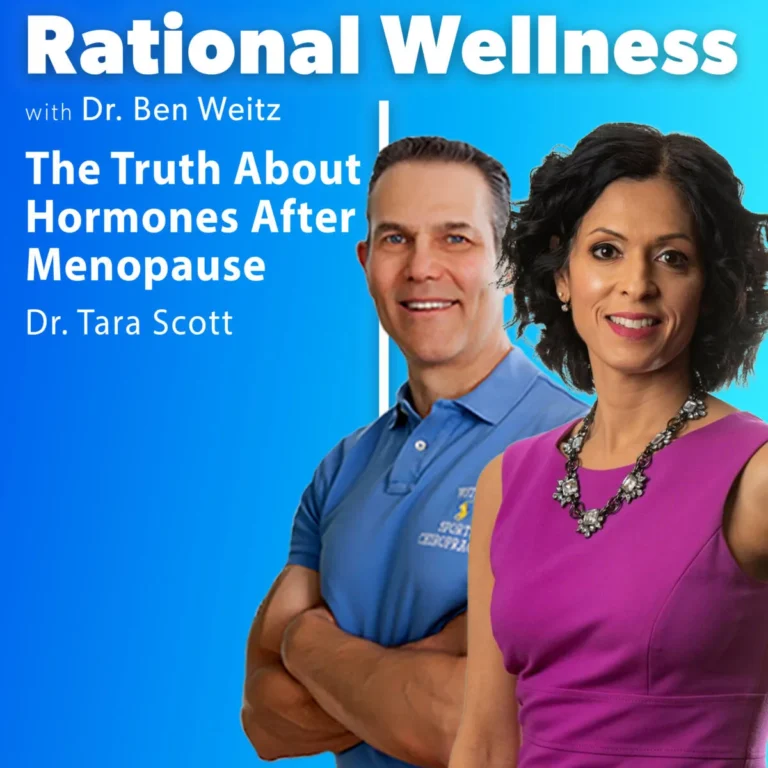
The Truth About Hormones After Menopause with Dr. Tara Scott: Rational Wellness Podcast 455
Reframing Menopause Hormone Therapy: WHI Fallout, Evidence Updates, and Practical Hormone Strategies with Dr. Tara Scott
Dr. Ben Weitz introduces the Rational Wellness Podcast and interviews Dr. Tara Scott, a board-certified OB-GYN and functional medicine physician, about menopause care and why hormone replacement therapy (HRT) use fell from about 27% to under 5% after the 2002 Women’s Health Initiative (WHI), despite later criticism of WHI design (older participants, specific oral Premarin/Provera) and newer data. Scott reviews current FDA indications, Menopause Society guidance that benefits outweigh risks for women 50–60 or within 10 years of menopause, and differences between oral vs transdermal estradiol and micronized progesterone. They discuss dosing based on symptoms and labs, progesterone/estrogen roles in sleep, fatigue mechanisms (progesterone decline, estrogen effects on thyroid binding), endocrine-disrupting toxins and testing, estradiol vs Biest, pellets, testosterone’s lack of FDA-approved options for women, DHEA/pregnenolone use and monitoring, initiating HRT later with cardiovascular workup, and lifestyle and stress management.
00:00 Show Intro and Mission
02:44 Why WHI Changed HRT
05:08 WHI Flaws and Fallout
09:21 Why Doctors Still Avoid HRT
12:45 Guidelines and Breast Cancer Risk
15:32 Lowest Dose and Five Year Myth
19:55 Fatigue and Hormone Shifts
22:02 Sponsor Apollo Wearable
23:35 Endocrine Disruptors Explained
25:40 Testing Toxins and Metabolites
27:44 Estriol vs Estradiol Debate
31:15 Insurance Friendly HRT
32:10 Pellets Pros and Cons
34:26 Dosing Labs vs Symptoms
36:03 Progesterone Cycling Strategy
37:35 Why No Female Testosterone
41:45 DHEA and Pregnenolone
43:26 Testing DHEA Correctly
48:55 Late Start HRT Safety
52:56 Sleep Hormones and Stress
55:18 Pandemic Stress Fallout
56:50 Courses and Closing
Dr. Tara Scott has become known as the Hormone Guru MD for her expertise in helping women navigate this transition using a combination of hormone replacement therapy, lifestyle medicine, and a functional medicine approach to individualized care. Her website is Dr.TaraScott.com
Dr. Ben Weitz is available for Functional Nutrition consultations specializing in Functional Gastrointestinal Disorders like IBS/SIBO and Reflux and also Cardiometabolic Risk Factors like elevated lipids, high blood sugar, and high blood pressure. Dr. Weitz has also successfully helped many patients with managing their weight and improving their athletic performance, as well as sports chiropractic work by calling his Santa Monica office 310-395-3111.
Podcast Transcript
rwp 455
Dr. Weitz: [00:00:00] If you’re looking for clinically useful insights, not wellness hype, then this is the place for you. Welcome to the Rational Wellness Podcast, the podcast for functional and integrated practitioners who wanna practice with greater clarity and precision. I’m Dr. Ben Weitz, and each week I sit down with the leading clinicians, researchers, and lab innovators to explore the science lab testing and clinical reasoning behind modern root cause medicine.
This is a show focused on practical evidence-informed insights that you can actually use in patient care. Please subscribe to the National Wellness Podcast on Apple, Spotify, or YouTube. Please tell your friends and colleagues and if you could give us a ratings and review on Apple or Spotify, we would certainly appreciate it.
Finally, to access the show notes and the full transcript, please go to my website, dr whites.com. [00:01:00] Today on the Rational Wellness Podcast, I’m excited to be speaking with Dr. Tara Scott, the hormone guru. Dr. Scott is a board certified O-B-G-Y-N and functional medicine physician who specializes in helping women optimize their hormones through perimenopause and menopause.
For many women, the transition through menopause can bring a host of symptoms, hot flashes, poor sleep, brain fog, mood changes, weight gain, loss of libido. Unfortunately, many women are told that these symptoms are simply something they have to live with, especially since the Women’s Health Initiative study, which was published in 2002 in the US in 1999.
Approximately 27% of women in menopause took hormone replacement. But after the Women’s Health Initiative, this rate dropped [00:02:00] to below 5% and continues to be approximately 5% even in 2026. After the World Health In Initiative study conclusions that taking hormones increases the risk of breast cancer, heart attack and stroke have been largely refuted both by flaws in the study and by newer research.
Dr. Scott has become known as the hormone guru for her expertise and helping women navigate this transition using a combination of hormone replacement therapy, lifestyle medicine, and a functional medicine approach. Dr. Scott, thank you so much for joining us today.
Dr. Scott: Thank you for having me.
Dr. Weitz: Great. So. Let’s start with, I brought up the Women’s Health Initiative and why since this study was published 24 years ago, are still less than 5% of women taking hormone replacement therapy despite all the symptoms of menopause.
Dr. Scott: Well, I think it’s important to back up a little bit before that study was published in 2002 and understand why the study was done. The study was largely looking at one drug, which I can say the trade names now. So Premarin and Provera, right? Which was the prescribed medication in the United States at the time. And that had lo, I think it was Premarin actually came out in 1942. So the safety studies had long been established in the seventies and eighties. They were seeing that this drug really helped heart disease and. Bone health, right? So what the reason for the study was is to get an indication from the FDA to prescribe hormone therapy for primary prevention of heart disease.
Currently, the FDA says there are four indications to prescribe hormone therapy. The first is moderate to severe vassor symptoms, which is hot flashes or night sweats, prevention of bone loss, premature menopause, which is before the age of [00:04:00] 45, and also something called genital urinary symptoms of menopause, which is painful intercourse, vaginal dryness, getting up to the bathroom at night.
UTIs. So they wanted it one more indication, which is prevent heart disease. If they were able to obtain that. That in that indication that meant their drug could be prescribed for every single woman because the number one killer in, in women is heart disease. Number two is stroke. Number three is lung cancer, and rapport is breast cancer. If you add up the deaths from two, three, and four, you still don’t equal the number of deaths from heart disease. So they could get everyone to take their drug for that indication.
Dr. Weitz: So, and by the way, it was widely understood that the reason why women had a much lower rate of heart disease prior to menopause was because of the protective effects of estrogen.
Dr. Scott: And while it’s tragic, when we hear about a man dying of a sudden heart attack in his thirties and forties, it’s almost unheard of to hear of a woman dying of heart attack in those ages, right? Unless she [00:05:00] was a diabetic or has some other medical issue. So the study was not done to see if the drug was safe.
The study was done to see if it actually prevented heart disease. So in order to do that, they had women who were older age, so that was the first problem. The risk of heart attacks and blood clots in, in your mid sixties is much higher than the risk at 50 or 52, which is the average age of menopause.
They had two arms of the study. One was women without a uterus who took Premarin only. The second was women with the uterus. 8,000 people got the drug, 8,000 got the placebo. And in that, what they found is that were eight more heart, eight more heart attacks and blood clots. And so it was a very small number.
Of untoward events, but it was wildly publicized. And because of that, the menopause society, the endocrine Society, you know, their indications were this hormone hormones cause this, but that didn’t take into account what kind of hormone, the dose of the hormone or that, so it really created a negative you know, [00:06:00] narrative that today still exists. As you mentioned, I di I hadn’t heard those latest statistics about that, so I’m glad you mentioned that. I knew it was still low. I didn’t know what it was in 1999. But I feel, I think it’s shifting these last two years, especially since the FDA pulled those warnings in November.
Dr. Weitz: I heard that, I also saw that California passed a law requiring doctors to treat menopause as a condition.
Dr. Scott: Wow. Wow. Well, we are a lot behind because I can
Dr. Weitz: tell you what, but it’s crazy that we have to have doctors, you know, pulled along on their hands and knees to agree to provide this incredibly, potentially beneficial treatment. It’s just hard to believe that it takes that long to change minds.
Dr. Scott: Well, you know, and women still to this day are having their ovaries removed and not offered [00:07:00] therapy. And you would never do that to a male, never remove testicles and not give them hormone replacement back girl. Right, right. Yeah.
Dr. Weitz: And it had to be men who decided, why don’t we give women hormones from a horse and see what happens.
Dr. Scott: Exactly. Well, there’s a, you know, these things are largely driven on profit. It was much cheaper before that. We used to use extract from pregnant pig ovaries, and you’d have to get 2,500 pregnant pig ovaries to make one milligram of progesterone. And we give 100 daily. So it’s very costly. Right. And collecting urine for pregnant horses was much cheaper. Yeah. So that is what drives a lot of this. Remember, it was a pharmaceutical being studied. It wasn’t, let’s look at the data on what the risks of just menopause are now. There’s been a lot of studies since then that have been done and prevent presented at the menopause societies. Like there’s been studies that said, since the WHI, when people have not taken hormones, what have we seen since then?[00:08:00]
More, you know, more mortality, you know, more cognitive decline, you know, those kind of things. And there was just a study published in February of 2024, looking at 7 million women who did take hormones. In the early two thousands. So in the early two thousands was after the WHI, but still primarily what people were taking was quite possibly prempro.
But even in that, with 7 million women over 65, they had an a 26% reduction in mortality overall, 19% less breast cancer, less lung and colon cancer. I think it was 10 and 16%. They did see with oral estrogen, dementia, and stroke increase, especially with oral Premarin, they didn’t see that with transdermal estradiol, though.
Dr. Scott: How was 7 million women compared to 8,000? Right. I mean, so even though that was observational data versus a randomized, as you know, when you’re studying a drug you have to have a placebo. You [00:09:00] have to have that type of trial when you’re studying, you know, outcomes and health, that kind of thing. I think large observational trials still give us some evidence, some good robust evidence, even though it’s not a randomized placebo controlled trial. ’cause there’s no, maybe no drug or intervention required, so.
Dr. Scott: I think today though, to your point though, if you polled 10 family practice doctors and asked them should women take hormones? I think nine would say no. Right. If you polled 10 gynecologists, I think eight would say no. I think the majority is still, and as I mentioned, I’m a traditionally trained ob, GYN, and I got zero training in menopause for a small time period.
I was giving those lectures to our local residency. But then when COVID happened, you know, everything kind of got disconnected. I fell off the lecture schedule and I haven’t gone really gone back. But that was four [00:10:00] lectures a year. That’s hardly a robust clinical education in menopause for a four year residency.
You know, so there’s a huge disconnect and I’m glad to hear that California is taking strides, that’s interesting, that doctors have to, we gotta start from the ground up. We’ve gotta educate people, right? That the data has to be out there. And it’s a lot, I don’t know where they would put it in the OB GYN curriculum, you know?
Dr. Weitz: Wow. That means I, unfortunately there’s no part of the curriculum that actually talks about promoting health.
Dr. Scott: Right. You’re right. Well, I mean, I can cut a baby out, you know, in a minute, under a minute, you know, in an emergency c-section. But, you know, preventative health is not really discussed. And again, you know, I think there, there are changing so that, you know, hopefully it’ll come and a lot of the doctors postdoc are interested in sub selecting to learn about hormones. And so hopefully I’m involved in a lot of educational tracks to try to educate doctors after they’re done. You know?
Dr. Weitz: Is it because the the societies or the organizations in medicine that make these recommendations that doctors tend to follow, haven’t. Gotten around to changing their recommendations. Is that why? Because I noticed a lot of MDs tend to go by whatever the, you know, the US preventative task force or whatever group, like, like about 10 years ago, they came out and said men shouldn’t get PSA testing because some men rush out and get surgery that they don’t need. Mm-hmm. And I remember having big arguments with my primary care doctor that’s ridiculous not to test, just because some men get surgery that they shouldn’t get, there’s no reason not to test.
And so, you know, of course he stopped testing and then it turns out that more men were being diagnosed with advanced prostate cancer, and now of course they’re going back to doing [00:12:00] PSA again. And it never made sense to withhold information. It makes more sense to just educate people about what to do about it.
Dr. Scott: Right, right. To know what to do about it.
Dr. Weitz: So, so is it because of the recommendations? Like what does the Gynecology Society say about hormones? Are they, so
Dr. Scott: That’s actually an interesting thought. There’s part of the situation currently right now, it’s still a combined obstetrics and gynecology, and then from there you could do high risk obstetrics. Reproductive gynecology and infertility, you know, gynecological oncology and incontinence. So it’s still a combined residency, which probably there’s so much now, you could probably split it to do GYN or ob, right? So there’s so much in there. So we have the American College of ob, GYN, which is primarily obstetrics, right?
This year at their annual meeting, they did have breakout sessions aimed at menopause. So they’re trying to create some menopause education. We have the Endocrine [00:13:00] Society, which is over, you know, medical endocrinology, but still puts out guidelines on women’s hormones. And then we have the Menopause Society, formerly North American Menopause Society.
Now the Menopause Society, that is driving a lot of the research and does put out a guideline, but if you actually look at their most current guideline, which was published in June of 2022, they say, what? The take home messages for women between 50 and 60 or within 10 years of their last menstrual period, that benefits far outweigh the risk of taking hormone therapy.
The risk of breast cancer is thought to be negligible, one out of 1000. So your risk as a woman just sitting there is 13% chance of getting cancer. Breast cancer, if you choose to take hormone therapy in the form of estradiol and micronized progesterone, which is FDA, approved bioidentical hormones, you’ll increase your risk by 0.1%, one out of 1000.
If you choose to take prempro, which not many [00:14:00] people do, that risk is a little bit higher, three out of 1000, in addition, in their position statements. So I don’t think people really read the thing, because in there it’s like, I don’t know. It’s 20 or 50 pages long. So in there for breast cancer, they say it hormones are not thought to be causative.
They’re not thought to increase the risk of breast cancer. If you are a patient who has breast cancer, it is generally not recommended to take hormone therapy. However, if you have severe vasomotor symptoms, unre unrelenting to non-hormonal hormone therapy, if you have any other, you know, things. Under the discussion with your oncologist, you may consider taking hormone therapy.
It never says in there that if your mom, your sister, your grandmother, your first cousin has breast cancer, you can’t take hormones. It says if you have cancer yourself, you may be able to take hormones. There was actually, I don’t know what the [00:15:00] body was that published, it was in the Journal of Menopause.
It just came out, I think this year on exactly this, on breast cancer. Should we offer them hormone therapy? And there are certain scenarios, triple negative cancers should be able to take cancer outside five years. There’s a thought that they might be able to take it. So it’s all laid out there. But people think, if my mom had breast cancer, if my sister had breast, it doesn’t say even anything about a first degree. It’s if you had breast cancer. So there’s a lot of still scared people and confused people.
Dr. Weitz: And what do you think about the recommendation that a lot of doctors make is that if you are gonna take hormones. Take the lowest dose possible to decrease symptoms.
Dr. Scott: Well, so that’s a whole nother thing. That was one of the recommendations that was put out by the Menopause Society after the WHI. Right? That. So if we think about, there’s two things that are still circulating. Lowest dose for maximum effect. That was one of the recommendations in [00:16:00] 2005, 2006. And then there was also the five year rule. Right. Take it for five years. That has been negated long ago by other position statements. Certainly the 2017 position statement.
And then the next one is 2 20 22. So there that is a whole nother can of wax because we have data published in the Journal of Menopause, which is a reputable peer review journal. Traditional journal that says these are the blood levels of estradiol that we know confer bone health. These are the blood levels that we have, that we know most women have a resolution of hormone symptoms. That’s all been published and documented. It’s just that you have to kind of dig forward and know how to use it. So,
Dr. Weitz: and if we know women prior to menopause have this much lower risk of osteoporosis, have a much lower risk of cardiovascular disease, have a much lower risk of dementia, then why shouldn’t that level of hormones be the one that’s recommended?[00:17:00]
Dr. Scott: Well, I think in our circles, yes, you’re right. We’re in prevention, we’re in optimal health. That is the goal and that’s how most of us practice and try to establish for each woman what is their optimal level for them. There is some data coming out though regarding that. I mean, again, it might be observa, A lot of it’s still gonna be observational, but there was one published I think five years ago in the women’s Alzheimer’s translational research that were almost 400,000 women who chose to take hormone therapy.
So it was observational, had a 58% reduction in Alzheimer’s and Parkinson’s, which is, you know, a motor thing rather than a cognitive decline in people who took hormone therapy over the age of 65. So we have some data out there. Again, almost 400,000 women, I think it was 396,000 women. So we have strong data with strong numbers stronger than the 5,000 and the 8,000 that were in the WHI studies.
So we do have data that says, you know. It’s not just [00:18:00] heart, it’s not just hot flashes, right? It’s bones, the death rate two years after a hip fracture is higher than 10 years after breast cancer. But everyone still fears cancer, right? But osteoporosis women are living longer. That is a very serious cause of mortality, right? Yes. And so I think the statistics were that, I don’t know what percentage never walked after hip fracture. And like I said, mortality rate after hip fracture.
Dr. Weitz: Yeah. I think it’s something like 30% mortality rate.
Dr. Scott: Yeah. Yeah. So it’s a serious thing. And with women living longer and then also the whole cognitive decline, I mean, people really feel fear dementia now. And we are seeing those risks of. The people who didn’t take hormones and what their brains are doing. Of course, we know there’s so many other things that correlate to that too. Brain health.
Dr. Weitz: I, I think we need to make sure in our heads that we have this concept that if you’re taking a medication that’s far into the body that might have [00:19:00] all sorts of possible effects, the idea of taking the lowest possible dosage to get a beneficial effect seems to make sense. But when you’re talking about just replacing the hormones that were already in your body naturally for decades of life, that taking that same amount does not seem like that. That’s, it’s something we should be worried about.
Dr. Scott: Well, it’s just like when someone has a thyroid removed, we don’t tell them, oh, you should only take the smallest amount of thyroid hormone. Right. Diabetic type one will, we should only give you the smallest amount of insulin.
Dr. Scott: Oh, we’ve figured out in a lab how to make human recombinant DNA insulin now. And so when I don’t know, when I trained, I, we used to give beef and pork insulin, so now we don’t even use, we use bioidentical insulin for people for, and we don’t try to rush in how much insulin they get. Right. You know, so I think that’s a great point.
Dr. Weitz: So, I watched one of your short videos where you talked about [00:20:00] fatigue being a symptom of hormone imbalance. And that’s we, of course, we all know about some of the symptoms we’ve been talking about, like hot flashes and sleep issues. Can you talk about how fatigue can be related to hormone imbalances or deficiencies?
Dr. Scott: So fatigue is probably one of the main complaints I hear from a lot of perimenopausal women, and that could be a couple things. One of the first hormones to decrease as you’re aging is progesterone and progesterone’s. A hormone produced after ovulation that helps you sleep. And so sleep starts, gets started, starts to get disrupted, not necessarily from hot flashes or night sweats, but just disrupted because of your progesterone levels not being as well.
So you’re not falling asleep as well. You may be not staying asleep. So sleep is poor. Sleep is one of the things, and that is related to less progesterone, but estrogen itself gives you energy. And so estrogen like testosterone for men and also testosterone for women is something that gives you energy.[00:21:00]
So what we do see is a couple scenarios. One is that in perimenopause you can have lots of big swings in estrogen, when estrogen is high, it increases a binding protein called thyroid binding globulin. So you have less. Free thyroid available to work. So maybe your thyroid’s making the right amount, but it’s like if someone took 75% of your paycheck and put in your 401k, you’d have that money, but you can’t use it, right?
You only have less cash, so you can’t even pay your bills now. So that’s what happens to your thyroid and your testosterone when estrogen’s high and binding proteins are high, and that’s the first thing we see that swings. And then as you go through the continuum that you’re starting to have less estrogen.
We do see women with lower energy as the same as testosterone when testosterone drops for women too, that contributes to fatigue. So one of it is primarily the drop in the less hormones that are made. The second is the effect of the changing hormones on the other hormone systems like thyroid, [00:22:00] and then of course your adrenal gland as well.
Dr. Weitz: What role do endocrine disrupting toxins play in hormone imbalances?
Dr. Weitz: I’ve really been enjoying this discussion, but I just want to take a few minutes to tell you about a product that I’m very excited about. Imagine a device that can help you manage stress, improve your sleep, and boost your focus all without any effort on your part. The Apollo wearable is designed to just to do just that, created by neuroscientists and physicians. This innovative device uses gentle vibrations to activate your parasympathetic nervous system, helping you feel calmer, more focused, and better rested. Among the compelling reasons to use the Apollo wearable are that users experience a 40% reduction in stress and anxiety. Patients feel that they can sleep. Their sleep improves up to additional 30 minutes of sleep per night. It helps you to boost your focus and concentration and it’s scientifically backed. And the best part is you can get all these benefits with a special $40 discount by using the promo code Whites, W-E-I-T-Z, my last name at checkout to enjoy these savings. So go to Apollo Neuro and use the promo code Weitz today. And now back to our discussion.
Dr. Scott: So that’s huge now. And I think even just in the 30 years that I’ve been in practice, it definitely wasn’t on my radar a long time ago because I don’t think we had the problem that we do now. And so endocrine disruptors can do a couple things. They can inhibit estrogen or they can act like estrogen. [00:24:00] They can inhibit your thyroid. They can inhibit your androgens. So we don’t really know. We ha we have some data on which ones act like estrogen versus which ones block the thyroid. Which ones, you know, I don’t think they do as much with progesterone as they do with estrogen.
Dr. Weitz: Do they actually act like estrogens or do they act like toxic estrogens?
Dr. Scott: They have a couple actions. One, they will agonize the estrogen receptor. And keep in mind though, there are, there’s an alpha and beta receptor at the estrogen receptor site, right? One is gonna cause growth, one is gonna cause, you know, growth. So we have not as much growth. We always say accelerate and breaks alpha, beta. And so you have some estrogens that don’t stimulate growth, some that do stimulate growth in the breast and the uterus. So we have estro, so endocrine disruptors act more like estro, which is a more harmful estrogen. But sometimes they also are involved in downstream signaling.
So maybe not the [00:25:00] receptor, but the metabolism of estrogen. So they’re in interfering with the metabolism of ’em. So it’s like you have a sink that won’t drain and so you have hormones kind of sticking around longer as well. And we all know that toxins harbor in our fat cells, and that’s where estrogen is made also.
Dr. Weitz: For those listening who aren’t familiar with endocrine disrupting substances, we’re talking about things like plastics, Bisphenol A, Teflon, flame retarding chemicals found in furniture and car seats, C phthalates you know.
Dr. Weitz: Yeah. And what about testing for these substances?
Dr. Scott: Actually, there’s a new test that I love called a hormone zoomer.
Dr. Scott: And I’ve been you know, working with ’em on some education and also, you know, testing it. It’s actually two tests in one, so the cost is obviously more than [00:26:00] one test because you’re getting the estrogen metabolites, plus you’re getting the endocrine disrupt.
Dr. Scott: So I love that. I think for a younger woman and really a woman of any age, but especially pre fertility, endometriosis, any of those women that are dealing with those estrogen symptoms, endometriosis, you know, that would, is a great test. So those are the people that I’m starting to run it on if they’re able to do the test.
So you get both of those. You get the endocrine or the endocrine disruptors and the levels, whether they’re, you know, red, green, you know, what level yellow, right? Safe levels. And then they give you a lot of the report’s really nice. They give you a lot of information on it. And then you also get the the estrogen metabolite levels and the cortisol so you can kind of see where they are and then decide what your treatment protocol is gonna be for them.
Dr. Weitz: Yeah. I suspect that’s something that is gonna become [00:27:00] commonly done.
Dr. Scott: Yeah. Yeah, I think it’s I think it’s a great adjunct of information and, you know, we still are learning a lot about these endocrine disruptors. We can’t really say confidently, like, if you have atrazine at this level, it’s gonna equal this mu much estrogen or this much whatever. We don’t know. But what you can do is you can do an intervention, especially armed with the estrogen metabolites and the detox pathways,
Dr. Scott: You can see where does the patient inherently have a blockage? Is it a genetic blockage? You can add genetic testing with that, or you can just do the things that will upregulate or inhibit those enzymes where you see the blockages put ’em through a detox protocol. And so it’s pretty exciting actually.
Dr. Weitz: Yeah. You mentioned alpha and beta estrogen receptors and the alpha receptor being more associated with growth than the beta receptor. Some women two. Some [00:28:00] female some doctors prescribing hormones. It’s been common actually in the functional medicine world to recommend topical bias cream that has a higher level of estriol than estradiol.
Partially because Estriol tends to hit the beta receptor more. And continued fears from WHI, I think is behind wanting to recommend estriol along with estradiol and possibly more estriol, however. Normal. Nor for women during normal menstruating times when they’re not pregnant. Estriol is only found in very small amounts, and it’s not really the normal hormone there.
I know my friend Dr. Felice Gers is a big believer in estradiol and not [00:29:00] estriol. What do you think about recommending the Biest cream that contains estriol with estradiol?
Dr. Scott: Well, we have the most data on estradiol in a lot of the studies, right? Because those are commercially available products. So we do know that estradiol.
Does what we say helps the bone, helps the heart. We don’t have the data on Estriol. And while I love having that option for my patients who are very sensitive to estradiol, like I just saw a patient yesterday that started on the very lowest amount of estradiol, but she can’t tolerate it. So for that patient bias is a great option.
I don’t use the 80 20 with 80% estriol I use. So we use an and, you know, and really where that came from is there used to be an 80 10, 10, and it used to be 80 in the form of ESTRO because physiologically in menopause estro was higher. So we used to prescribe something called tris, which is 80% Es tro 10%, 10%.
But as you know, [00:30:00] that led to a much lower amount of estradiol. You have to have a certain amount of estradiol to get the benefit on the bone in the brain and then symptom resolutions, right? So while I think there’s definitely a. Time and place for biased, and I do prescribe it. I prefer the 50 50, so you’re not shorting the patient of the amount of estradiol that they’re getting.
And they, there are some people that just tolerate it a little bit better and they don’t seem to tolerate the estradiol alone. So that blend seems to be a little bit better for them. You know? We don’t have the robust study on the compounded hormones because it’s not a patented formula, and no one’s gonna fund that, although.
If you have a reputable compounding pharmacy that has possibly going through the P crab accreditation through their governing body I think that, you know, we, I have been very fortunate to live in a town where we have a high quality compounding pharmacies, a couple, and for, I’ve been able [00:31:00] to use those for 25 years. So it’s a great option for women who are sensitive or who are, you know, who need cer a little bit different, but if I’m honest, most of our patients just take estradiol.
Dr. Weitz: Okay. And so are you giving most of your patients the FDA approved estradiol patch?
Dr. Scott: Yeah, that’s what we start most of our patients with. You know, I practice, like we said in Ohio, so a lot of our patients, you know, we’re middle America, they wanna use their prescription coverage from their. Their insurance. So the copays, you know, are usually reasonable. They come in generic. We start with FDA approved estradiol patches, micronized progesterone.
Both are FDA approved. If there’s an issue. There’s also an f FDA approved estradiol gel that we use a lot daily sachets. I’m not a fan of the pumps because they’re a little bit higher doses and long, longer, half-life. But there is a daily one that comes in five strengths. So [00:32:00] I would say 90% of our patients do well with that.
And then those that don’t, that have an intolerance to a certain point, then we might move to the biased. And the compounded options, and there are, what,
Dr. Weitz: what do you think about pellets?
Dr. Scott: So I think there is a subset of people who do well with pellets, those that just cannot remember a daily dosing or something. And I, while I’m trained to insert pellets, I don’t have the clinical experience of managing pellets. I’ve only had the. Pellet problem patients come to me, you know? So I can’t objectively speak about it. I have a colleague who I do trust, who’s knowledgeable and does mostly pellets in her practice. So I believe there is a way that it can be done.
You can’t get a progesterone pellet ’cause it’s too large of a molecule. So we’re mainly checking, talking about estradiol and testosterone. And what I’ve seen in my practice, at least initially starting hormone therapy is. First of all, we don’t have to wait till 12 months after your period. We could potentially be starting it in late perimenopause once you’re skipping pers.
So the definition of [00:33:00] perimenopause is once you’ve gone 60 days, okay, so women are very symptomatic in that, those late perimenopause years. So we are starting estrogen. So when we give it, they might be low, then their body might produce it, then they might be low. So in those erratic times, it’s hard to have a pellet that’s already in there giving you a certain amount.
So I find it hard to do that now for testosterone. It might be better again. But the dosing protocols that I’ve seen from some of the companies I think are leading to like super physiological levels. Now, I’m not saying that everybody does that. If there’s individual dosing and there’s individual monitoring.
Somebody might be doing it differently, but some of the protocols I’ve seen are lending towards those really high serum levels. So I do think there’s a patient population that it can be used and you know, somebody who’s just so busy they can’t even bother to fill their prescriptions and their, you know, the busy executive for woman tra.
I have some of those patients that travel all the time, you know, and [00:34:00] that would be great if you could dial in the level and they were done with the rollercoaster. I think the pellets for men probably work well because they don’t have as much variation. So I think there is a market where it can be used. I wouldn’t say I am one of those pellet haters. I just have found a way to make it work with things that are potentially covered under the patient’s insurance.
Dr. Weitz: Do you base the amount of hormones you recommend on testing or on symptoms or both?
Dr. Scott: I use a combination of both. I mean, basically we have data saying what the, you know, protocol levels are of what the commercially available products are. So I always like to start on the lowest dose and titrate up from there based on levels and symptoms. We do have, as I mentioned, a couple studies in the Journal of Menopause that document serum levels that are optimal for women. But I don’t think you can just look at just the lab, right? You gotta look at the patient, how they feel.[00:35:00]
Everybody’s individual. So if the patient, so there’s two scenarios. One is the patient’s still having hot flashes and you think her level looks okay, and you think that she’s on a high level of Es of estrogen, but she’s still not having the resolution of symptoms. Now again, hot flash is a difficult one because it’s not just estradiol.
It could be testosterone, it could be cortisol, it could be a lot of things. Or you have the patient who’s not symptomatic by the symptoms, you have decided estrogen or hot flashes, sleep. And she is losing bone, you know? So then how do you know that you have her on the right dose based on her symptoms?
Unless you’re checking the DXI scan, which you have to have two to three years for to be able to look at that. And you know, cholesterol is another metric and inflammatory things. I have some women who, it’s not hot flashes, it is energy, like we talked about earlier. It is autoimmune flares, it is dry eyes. It is something else that is a miserable symptom for them. So we do use a combination of symptoms and [00:36:00] levels
Dr. Weitz: When it comes to progesterone, do you like cyclic use of progesterone like two weeks out of the month or do you do it continuously?
Dr. Scott: For a cycling patient, we do it cyclic and we try to match the normal menstrual cycle. So we either give it starting on day 15 around ovulation, and the perimenopausal patient will give it around 10 for a postmenopausal patient. It still is a combination. So some women, when they’re taking oral progesterone at night, you know, the half-lifes only about six hours, so there’s very little accumulation from an oral com oral, non-compounded, and even oral compounded medication. So, part of the reason to do non-cyclical to do cyclic would be if you’re worried about receptor fatigue, that, you know, binding a receptor every day is not gonna be accurate if you’re worried about accumulation with the oral form of progesterone, which is favored once you are giving estrogen because of endometrial production. Usually you’re not getting accumulation of [00:37:00] progesterone doses if you’re using a topical and perimenopause. Yes, you can get an, you know, topical accumulates of any medication, whether it’s,
Dr. Weitz: Or maybe you’re just trying to duplicate the natural release of progesterone?
Dr. Scott: And that’s what we’re doing for people who are perimenopausal. But for postmenopausal, there isn’t a natural release of it because there’s no ovulation and no corpus lium. So if we’re doing anything that’s a sick, a cyclical it would be usually one day off a week or four days off a month consecutively. And that is highly dependent on how the patient feels.
Dr. Weitz: Okay for testosterone, why isn’t there a FDA approved testosterone on the market for women?
Dr. Scott: So there was a lot of studies on a testosterone patch, which is a 300 microgram patch, and so we have some data saying that the ovary produces in. Pre menopause, about a third of a milligram a day for healthy women. That was the, that [00:38:00] was what they determined based on data. And so they were looking at a 300 microgram or a third of a milligram patch for women. And, you know, estrogen does really well as a patch. Estrogen and testosterone are very similar hormones. So they, they did a lot of data on it, found good levels, found good relief. You know, they were looking mainly for the indication of low libido, which we now know testosterone has to do with so much more than just libido, than muscle mask, stamina, mood, memory the structure of your brain, your hair, your skin a lot vaginal dryness.
So in those studies, they were looking more libido, which is so subjective for a woman. I mean, there’s so many things that could correlate that there wasn’t any concern with the data and the efficacy that they saw in those studies. They said there just wasn’t enough data, but they passed testosterone based on the same amount of data for men. So I don’t know if it became that they didn’t think they could market it, because I did hear that they were gonna [00:39:00] try to market it in Europe, you know, and I don’t know if it’s available in Europe. I’m actually not sure if it ever came to fruition. Was it a business thing that they didn’t see it was gonna be profitable and they couldn’t get the cost, you know, to be at A-A-A-R-O-I that was good, but it didn’t come to market, not based on safety concerns.
And like I said, they passed the male testosterone with a similar. Set of data and amount of data. So we do have a global consensus of testosterone published in 2019 said that, you know, don’t use serum levels to assess testosterone because you could have normal testosterone and low libido and vice versa. But it’s indicated for postmenopausal women with low libido, but we have no FDA approved testosterone. And so I see some of our traditional menopause influencers saying, oh, get a male testosterone tube, or this sachet. And if you get [00:40:00] one. Prescription. It’s good for a year. And I worry about what’s the beyond use date on that topical medication?
Is it 12 months shelf life? You know? And so secondly, how can you say if these are sachets that are five grams and we need to give a women a woman 0.5 grams, you know, or five milligrams, sorry, it’s five milligram. Five milligrams versus 0.5 milligrams, how can you titrate a 10th of a packet, right? So it’s an inexact. Give yourself a dab and do this. And so I know there’s some of that has been advised for people, which I guess is better than not having any, but they’re also not really monitoring those correctly. So I, if I’m going to use testosterone, I really prefer to use a compounded dose for a woman, you know, in some of the dosage forms, sometimes we do use injectables using a male dose and giving a smaller amount less frequently, and that can work well for some. Sometimes we have compounding pharmacies, compound injections as well. [00:41:00] So, I don’t know why there’s not, I do know I am involved with a company that’s trying to, you know, bring a product to market, so that takes a while. It’ll be a
Dr. Weitz: couple. How often do you recommend testosterone for women?
Dr. Scott: It seems like it’s happening more and more lately because we’ve always checked it. We, I just, since COVID, we’re seeing so many people with so much lower testosterone, and that’s a direct relationship or sequela of stress. Stress can deplete your testosterone, depleting your DHEA, you know, there’s no feedback loop from DHEA back to the brain saying, Hey, DHA is low. So a lot of women are walking off low androgens. So it seems like more and more I am treating women with testosterone.
Dr. Weitz: Do you recommend DHEA and/or pregnenolone?
Dr. Scott: Yeah, we recommend both of those in our practice when indicated. And so pregnant alone, again, there is no commercially available product. There are a few high quality over the counter [00:42:00] supplements that we trust, and we also can get it compounded by our compounding pharmacist.
Pregnenolone would be something that would be helpful for somebody with a low cortisol. Kind of pattern anxiety, pain issues that’s the energy issues, those, that’s the type protocol I like to see. Although you can measure pregnant alone by Quest or LabCorp, an 8:00 AM pregnant alone, I do like to see a cortisol curve in those patients first to see what’s going on with the whole picture.
DHA I’ve been using that. There’s so much data on DHA. We do have a commercially available product that is marketed for post-menopausal vaginal atrophy in the form of a suppository. But in order to bring that drug to market, they still have to do all four phases of the FDA cycle, including oral safety efficacy. And so those studies are out there by the company, mostly authored by Ferdinand Libre, who spearheaded a lot of that data on DHEA. And due to the fact that it is a prohormone with no receptor, [00:43:00] it exists to turn into either estradiol, aone, or testosterone via Andersen, Dion and Aromatase. So, I’ve been using that in my practice for 20 plus years with very, very well.
Dr. Weitz: Do you use the Bezwecken cubes?
Dr. Scott: I don’t know what the Bezwecken cubes are.
Dr. Weitz: Oh, okay. It’s a DHEA vaginal product.
Dr. Scott: We would just, I would just have it compounded at a pharmacy.
Dr. Scott: Use that. Yeah.
Dr. Weitz: So, is there a blood level, DHEA that you like to shoot for?
Dr. Scott: So depending on the labs that you’re looking at, if you’re looking at D-H-E-A-S, it’s somewhere around 30
Dr. Weitz: D-H-E-A-S. Yeah.
Dr. Scott: 32 to 237. And around the time of menopause, most women feel good with a DHEA about a 150. Some people have a Sulfatase snp, so they’re pushing it down that DHAS pathway. So we also check DHA Unconjugated, so you’ll see a postmenopausal level be anywhere from, I think 77 to 700. So the median is about 400, and the follicular ranges are anywhere from 3 85 to 1195, give or take. Don’t quote me. Exactly. And then luteal levels are a little bit higher. So we do look at Unconjugated, DHA as well as DHA.
Dr. Weitz: Okay, ex. Explain that one more time please. For practitioners who are listening why do we sometimes want to get Unconjugated, DHEA levels?
Dr. Scott: So DHEA is what’s produced in your adrenal gland, and it is the most populous hormone. So as an example, a woman who’s still menstruating could have a level anywhere from high three hundreds to 1200. Okay? So that’s a large range. D-H-E-A-S usually is through the sulfation pathway, which is one of the, detox pathways of estrogen as well. So that happens in the liver. It gets sulfated in the liver, and we see D-H-E-A-S as normal range as anywhere from 32 to 237.
So [00:45:00] much smaller window. I have patients who, no matter, and I’m one of them, no matter what, it’s just, that’s always high because you have a sulfatase snip, meaning you’re pushing things down that pathway. So whether I’m taking DHA or not, it’s always high. And so it’s not an effective way to monitor DHA for me. So you gotta look at the unconjugated DHA. So we order both the DHE Unconjugated and the D-H-E-A-S.
Dr. Weitz: I’ve heard some practitioners like to push the DHEA levels higher. I’m always kind of, I don’t prescribe hormones, but I we sometimes do recommend DHEA ’cause it’s over the counter. I’m always nervous about DHEA levels getting too high because of possible hair loss or other side effects.
Dr. Scott: You can definitely get side effects from too much. You’re right. And that is a precursor to testosterone. So all those androgen side effects of you know, hair loss, oily skin acne are [00:46:00] possible. And I have had some patients that, that enzyme, five alpha reductase, if it, they have a predisposition down that pathway. They take a little bit of DHEA and they’re convinced their hair falls out the next day. You know, we know that hair grows in three month cycles and it doesn’t usually happen that much, but they swear that taking DHEA when their levels are low, and that has to do with how they are shunting their androgens down that pathway.
So other than those physical symptoms, you, we know if you’re using testosterone in excess, like pellet levels, whatever, clit, mely and voice, you’re lowering, your voice is irreversible in women. That’s an irreversible side effect from too much. So those are things you really don’t wanna push. The testosterone pathway, I don’t know that we have any data of high dose DHEA it causing that same.
Thing and levels. Now, when you give DHEA, it has a 36 hour half-life. [00:47:00] So if you’re testing a level and patients have taken it within that 35, 36 hours, you might see falsely elevated levels and the assays of testosterone free testosterone dihydrotestosterone also get interfered with the DHEA supplement, which is why we recommend our patients hold their DHA for 48 hours. So in essence, with that hormone, you’re getting a PA trough level rather than a peak level. We normally prefer to get peak levels of the hormones that we’re dosing, but except for DHA, because it led to confusing results with that. So, back to your original question.
Dr. Weitz: Oh, say that one more time real quick. So you’re asking the patients not to take their DHEA for a couple of days.
Dr. Scott: For 48 hours. Because what I had seen is they took it even the day prior and didn’t take it the day of the lab, you’d see the lab be high and you’d think, oh, you’re on too much. So then we decrease the dose and then they’d be too little. So what you’re getting in the blood is the drug and not the [00:48:00] patient’s level. So
Dr. Scott: that’s how we’ve started doing that a few years ago and it seemed to be a little bit more accurate to what the patient is doing. And if you think about it really, because we all have adrenal glands, whether you have ovaries or not, you shouldn’t, you should know, want to know what the endogenous levels are, right?
Is the adrenal band producing anymore? Have we supplemented those levels? So that’s just been my practice pattern and it seemed to work well. But I think your original question was, is there any concern with pushing those levels high? I mean, I think if they’re just outside the range, other than the side effects, it’s, that’s a great question.
I don’t know that I’ve seen the Ctor Mely or the voice changes with really high DHEA levels. Yeah. You know, you get a hundred milligrams over the counter people dose themselves.
Dr. Weitz: Yeah. If you want to study high levels of testosterone, just study some of the female bodybuilders.
Dr. Scott: Yeah. For a woman to take that much, that’s a lot, you know?
Dr. Weitz: Yes. What do Dr. Dale Bredesen, who’s been pioneering a [00:49:00] functional medicine approach to reversing and protecting against Alzheimer’s often will recommend to older women who have not taken hormones to take estrogen and progesterone. What do you think about recommending estrogen and progesterone to older women who didn’t start during perimenopause?
Dr. Scott: So I think the data that we have of the higher risk outside of the 10 year window is on o old preparations, oral estrogen, synthetic progestins, prempro. I don’t know that we have that data on transdermal estradiol, which I believe is mainly what I’m seeing bresin practitioners use for sure. And I know that they’re also pushing levels pretty high for those patients. So we do have, like I said, that 7 million women study. That was some older ages that was, that’s some great data. I have absolutely started it outside of the 10 year window for my patients. I do a full cardiovascular workup. Prior to that, of course there is a study [00:50:00] floating around, which I cannot reference that said, if someone is remote from menopause, 10 outside of the 10 years and they have plaque already and then you.
Give them estrogen, it can precipitate the release of plaque and cardiac event. I don’t, I can’t give you the reference, I can’t tell you that we have that. So that’s my reasoning be between doing a full advanced lipid panel with the wrist proteins and a cardiac calcium score often before we’re starting patients on estrogen. But I have started patients outside of that 10 year window and I, and they’ve done well.
Dr. Weitz: Right. I’ve seen that too. I think one of the tricky things about women in heart disease is it’s often unrecognized and I’ve. Discuss this with some of the top functional medicine cardiologists and it’s not really on their radar very much either. They tend to feel that women [00:51:00] have the same heart disease as men, but I think there’s growing data that a percentage of women have a different type of heart disease that’s not directly related to plaque in the coronary arteries.
Dr. Scott: And so we generally evaluate a high sensitive CRP. We’re looking at Lp(a) A OB and as well as an advanced lipid profile. And we’re fortunate that still in our area, a coronary calcium score is no cost to patients. I don’t know how long that’s gonna happen. I don’t think that we have the clearly or the heart flow in our area that’s looking at soft plaque. That would be our next step for patients.
Dr. Weitz: Well, well, one of the concepts is that there’s some different type of heart disease that we might call small vessel disease.
Dr. Scott: Yeah. So I mean, that would definitely be something
Dr. Weitz: Which isn’t even included like a clearly test. You know, I talked to one of the experts on clearly [00:52:00] about could we change the test to visualize this type of heart disease that women sometimes get.
Dr. Scott: And so if you’re talking about an occlusive disease, then if it’s in small vessels, there would probably be some other manifestation of like either a Rena syndrome or migraines or some other vaso-occlusive phenomenon that would, you know, mimic something like that. And so if you’re eliminating a thrombotic event, right, so that’s a different form of
Dr. Weitz: Yeah, it’s often referred to as like microvascular disease. Yeah.
Dr. Scott: Yeah. So I would, you know. Yeah. That’s interesting. I can’t say that I feel like I’m an expert in that area.
Dr. Weitz: Right. Yeah. No, I think it’s kind of emerging.
Dr. Scott: TBD then, huh? Yeah. Sounds interesting. Yeah. But it makes sense.
Dr. Weitz: Yeah. I saw one of your blog posts where you were talking about [00:53:00] sleep, and we know how important progesterone is for sleep, and in fact, progesterone is actually turned into a neurosteroid, correct? Yes. But estrogen also plays a role in sleep.
Dr. Scott: So in my experience, progesterone helps you initiate sleep, but estrogen helps you maintain sleep. So when we have a patient that says, oh, I’m falling asleep, okay, but I’m waking up at 4:00 AM a lot of times it’s low estrogen. I mean, it could be the cortisol that 4:00 AM spike. So, you know, we all, in some of our chest, we also are able to measure melatonin as well, which, you know, mirrors cortisol. So if cortisol’s high, you know, melatonin starts to be high in the morning, but not high at night. And so, the, but I believe it’s not just progesterone, but you also need the proper amount of estrogen to be able to maintain your sleep cycle.
Dr. Weitz: Right. And obviously diet and lifestyle is also super important for managing menopause cause.[00:54:00]
Dr. Scott: Absolutely. You know, I would think it’s equally as important as the drugs, you know? Right. We have a hard time handing out a prescription without discussing all the other things that are necessary for optimal health. You know, including any anti-inflammatory diet. We talk a lot about eating, timing and eating pairing in our practice as far as women, because we know that when they go through menopause, their basal metabolic rate lowers and no amount of exercise and eating less will help combat that.
You know, but there’s studies that show that giving estradiol does help that. So we do talk about that with patients. And the other big pillar, you know, besides for what you eat and how you move your body is really what you do. What you do with stress. Like you can’t avoid the stress, you can’t really manage it, but how do you protect your body from the effects of stress and what is your stress level? So we do work with our patients on that as well.
Dr. Weitz: [00:55:00] Yeah, I think we have to find some ways to manage stress using strategies like breathing exercises and meditation and exercise and you know, things like that where there’s no way to avoid stress for sure in modern life.
Dr. Scott: Right. And especially now since the pandemic, I mean, there may have been people who didn’t have stress before, but there’s certainly seem like there’s anybody with no stress now.
Dr. Weitz: Sure. Yeah. Make everybody fearful for the rest of their life.
Dr. Weitz: I feel sorry for some people. Sometimes you go to the grocery store and you see people and they’re still scared to death with the masks and the gloves and everything, and they’re just, I guess for the rest of their life, they’re gonna be in that fear. Yeah. I can’t only imagine what the long-term negative consequences of all that is.
Dr. Scott: Yeah, I know. I mean, just the fallout of everything.
Dr. Weitz: And the interesting thing is I suspect we may [00:56:00] have a big increase in autoimmune diseases because we have this whole hypothesis that seems to be. Somewhat accurate that not getting exposed to germs increases our risk of autoimmune diseases. And now you got people who have been living for years in this bubble of like, yeah, I can’t ever get near a bacteria or a virus.
Dr. Scott: Yeah, that’s a good point. I didn’t think about that. That’s true. Right. I mean, that’s certainly things that we’re gonna see the fallout of all this.
Dr. Weitz: I tell my patients, forget about those antibacterial wipes when you go to the supermarket, lick the handle of the cart.
Dr. Scott: Oh, that’s a good, that an eating jerk, right?
Dr. Weitz: Just kidding. For anybody who’s listening. Yeah. So, let’s wrap this up. Tell us how you have some courses for practitioners to get training on hormones.
Dr. Scott: Well, we’re, we are in the [00:57:00] process of remodeling the practitioner facing courses. Okay. We do have a lot of free downloads for patients, you know.
Dr. Scott: Testing guide. So
Dr. Weitz: How can patients get in touch with you?
Dr. Scott: Yeah, so most of our stuff is on social media. I’ve got a YouTube channel that they can subscribe to. Hormone Guru, you’ll find me that way. Or Dr. Tara Scott on TikTok, hormone guru MD on Instagram. We do have free downloads that I know a lot of practitioners have also downloaded our testing guide for perimenopause, our natural therapies for antidepressant.
We do have a patient facing hormone course as well that that we have currently that is there that I know a lot of practitioners have gone through and found helpful as well. Okay. And
Dr. Weitz: what’s your website?
Dr. Scott: Is Dr. Tara Scott and we also have a weekly, mostly most of the time weekly newsletter as well. So yeah, we
Dr. Weitz: have a mostly weekly newsletter.
Dr. Scott: Yeah. Yeah. And you know, we are, we’re trying to revamp the mentorship. I had to put that on pause as some things got kind of [00:58:00] busy as some other initiatives. I was doing some other teaching through the fellowship, through UCI and IPI. So, hopefully that’ll come back soon, but if you get on the website or the sub the newsletter, that’s a way to be abreast of all announcements.
Dr. Weitz: That’s great. Thank you so much Dr. Scott.
Dr. Scott: Oh, thank you for what you do in getting the information out there as well.
Thank you for making it all the way through this episode of the Rational Wellness Podcast. For those of you who enjoy listening to the Rational Wellness Podcast, I would very much appreciate it if you could go to Apple Podcast or Spotify and give us a five star ratings and review. As you may know, I continue to accept a limited number of new patients per month for functional medicine. If you would like help overcoming a gut or other chronic health condition and want to prevent chronic problems and want to promote longevity, please call my Santa Monica Weitz Sports Chiropractic and Nutrition office at 310-395-3111 and we can set you up for a consultation for functional medicine and I will talk to everybody next week.